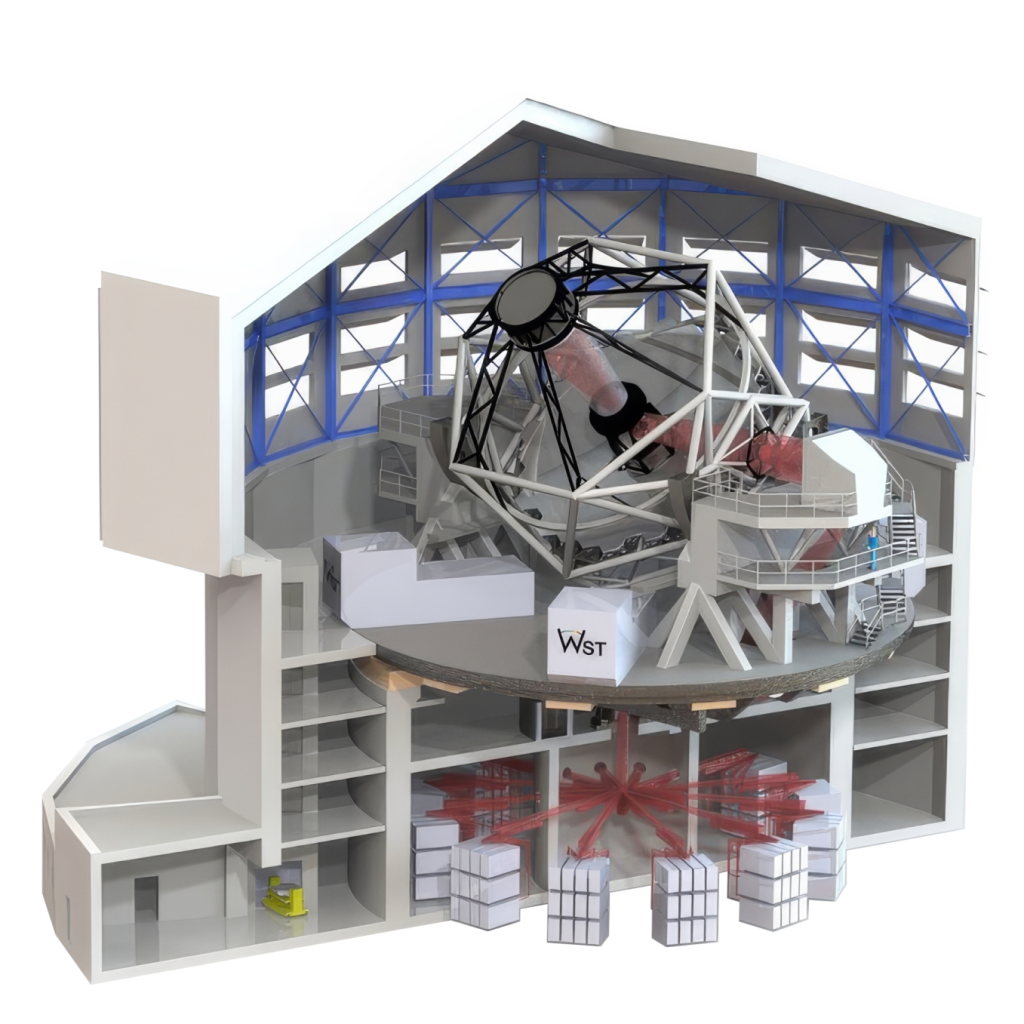
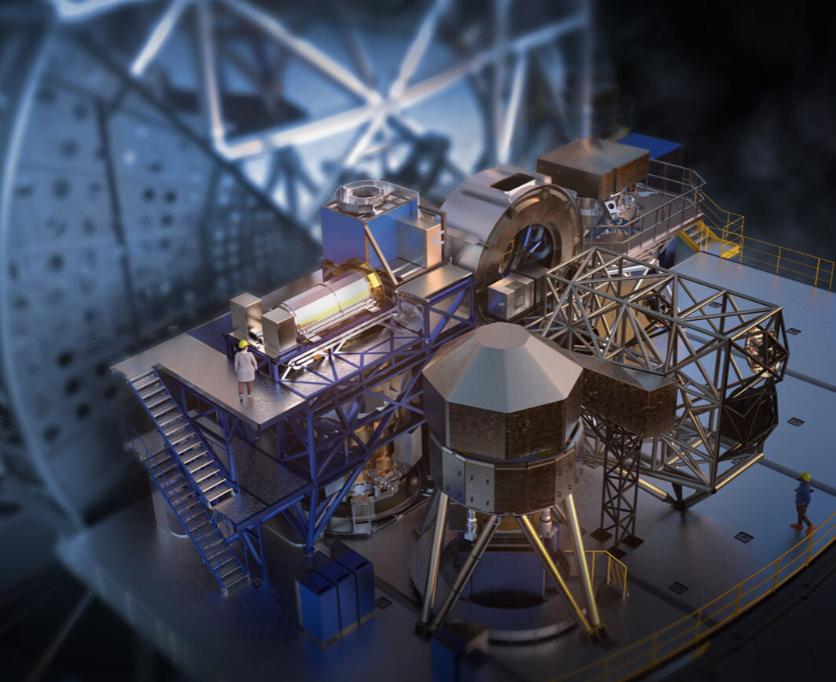
The Wide Field Spectroscopic Telescope (WST)
Wide-field Spectroscopic Telescope (WST) is a proposed 12-m class dedicated spectrosscopic facility envisioning the simulateneous operations of a large fied-of-view and high multiplex (30000) multi-object spectrograph (MOS, both at low and high spectral resolution) and giant panoramic integral field spectrograph (IFS). WST aims to complement the other astronomical facilities of the 2040s, including ELT and the SKA, by providing spectroscopic follow-up for the billions of sources that will be discovered by the next generation of imaging surveys.
Key research themes for WST include: the formation of the first stars and galaxies and their role in cosmic reionisation; the distribution of dark and baryonic matter in the cosmic web; the expansion history of the Universe; the baryon cycle in galaxies and the origins of the elements; the assembly history of the Milky Way and its satellites; the origins of stars and planets; and the study of transient phenomena, including the electromagnetic counterparts of gravitational wave events.
The WST project is currently in the conceptual design phase, funded by an EU infrastruture grant. The team aims to present the WST concept to the ESO Expanding Horizon initiative, to be considered as a future facility for the ESO community after the ELT. I am leading the science case development for the Extra-galactic science theme (co-leads: Ellis and Sargent).
Team members involved: Laura Scholtz Diaz (postdoc)
Key Team Members:
Roland Bacon (PI, CRAL),
Vincenzo Mainieri (Project Scientist, ESO),
Sofia Randich (Co-PI, INAF),
Richard Ellis (Co-lead, extragalactic, UCL),
Mark Sargent (Co-lead, extragalactic, EPFL)